You’ve booked the venue, locked in the speakers, and sorted the catering. But there’s one decision that
quietly makes or breaks the entire experience for your audience: the microphone. Get it right and
nobody notices (which is exactly the goal). Get it wrong and it’s all anyone talks about.
After more than two decades in live sound, supporting festivals, corporate events, exhibitions, concerts,
and a wide range of high-end productions, I’ve seen how the wrong mic choice can derail an otherwise
flawless event. This guide walks you through everything you need to consider before you decide.
Start Here: Ask These Questions Before Anything Else
Before you even look at microphone types, you need to understand the environment and the person using it.
These four questions will immediately narrow your options:
- What is the speaker doing? Are they standing behind a podium, walking the stage, sitting on a panel, or
moving through a crowd? Movement is the single biggest factor in mic selection. - What does the venue look like? A small boardroom, a 500-seat auditorium, and an outdoor festival
stage all have completely different acoustic demands. - Who is the speaker? A keynote presenter is different from a comedian, a pastor, or a CEO who keeps
looking down at their notes. Their habits matter. - What are the aesthetics of the event? A high-end product launch or awards ceremony may require a
solution that’s nearly invisible on camera and on stage.
Once you’ve answered those, you’re ready to evaluate your options
The Four Main Microphone Types and When to Use Each
- Handheld Microphone
The handheld is the most recognisable microphone in the world, and for good reason. It’s reliable, easy to
use, and gives the speaker direct control over their own sound level by adjusting how close they hold it.
Best for:
- Live music performances and concerts
- Panel discussions with a host passing the mic between guests
- Q&A sessions with audience participation
- Award ceremonies where recipients aren’t pre-fitted with a mic
What to consider:
The biggest limitation is that it occupies one hand, which restricts natural gestures. It also requires the
speaker to maintain consistent mic-to-mouth distance, something many untrained speakers forget. Drop the
mic too low and you lose clarity; hold it too close and you risk plosives and distortion.
For events, always choose a wireless handheld to avoid cable hazards on stage. And if multiple people will
be sharing it, factor in hygiene: foam windshields should be replaced between users.
When to avoid it: Corporate keynotes or presentations where the speaker needs both hands free, or events
where a visible mic would detract from the professional look.
- Lapel Microphone (Lavalier)
The lapel, also called a lav or lavalier, is a small clip-on microphone typically attached to a lapel, collar, or
tie. It’s the go-to choice for broadcast, corporate events, and anywhere you want the mic to be discreet.
Best for:
- Corporate conferences and keynotes
- Award shows and galas
- Broadcast interviews and recorded events
- Panel discussions where speakers are seated
- Theatre and drama productions
What to consider:
Placement is everything with a lapel. Ideally, it sits in the centre of the chest, roughly 15–20cm below the
chin. Too far to one side and you lose consistency when the speaker turns their head. Clothing noise is a
real concern: a speaker in a silk blouse or a stiff suit jacket can create constant rustling that’s very difficult to
fix in the mix.
Also think about clothing colour and visibility. If the event is being filmed, a black mic on a white shirt will
stand out. Most AV providers carry mics in multiple colours for this reason.
The wireless transmitter pack (usually clipped to the back of a belt or inside a pocket) needs somewhere to
live, something to discuss with speakers in advance, especially women in fitted dresses who may not have a
convenient place to mount it.
When to avoid it: Outdoor events with strong wind (wind noise is amplified significantly), or situations where
you can’t guarantee the speaker will stay dressed consistently throughout the event.
- Lectern Microphone
A lectern mic, sometimes called a podium mic, is a fixed microphone mounted on a stand at a speaking
position. It requires no fitting, no wireless pack, and virtually no instruction for the speaker.
Best for:
- Formal speeches, ceremonies, and graduations
- Political or civic events
- Religious services
- Any event where multiple different speakers rotate through a single position
- Situations where fitting wireless mics to every speaker isn’t practical
What to consider:
The lectern mic is the most forgiving option for untrained speakers because the correct distance is built into
its physical position. However, it completely eliminates mobility. The moment a speaker steps away from the
podium, they’re off-mic.
Because the mic is fixed in one spot, it picks up everything in front of it, including papers being shuffled,
glasses being placed down, and the speaker’s own breathing if they lean in too close. Positioning the mic
slightly to the side of centre (rather than directly in front of the mouth) reduces breath noise significantly.
For large venues, consider using two lectern mics in an X-Y configuration to ensure even coverage and as a
failsafe if one develops a fault mid-speech.
When to avoid it: Dynamic keynote presentations, events where speakers are expected to move or use the
full stage, or anything requiring a high-production feel where a fixed podium looks too formal.
- Headset Microphone
The headset mic sits on a lightweight frame that wraps around the head, positioning a small capsule just to
the side of the mouth. It’s the secret weapon of presenters who need to move freely while maintaining
consistent, broadcast-quality audio.
Best for:
- Conference keynotes with active presenters
- Fitness instructors, performers, and presenters who use the full stage
- Theatre and musical productions
- Presenters who use hand gestures heavily and can’t hold a mic
- Events where consistent mouth-to-mic distance is critical
What to consider:
Because the mic moves with the speaker’s head, the distance to the mouth stays constant regardless of
where they look or how much they move. This makes it the most technically consistent option of all four
types.
The main challenge is aesthetics and comfort. Headsets are more visible than lapel mics, which can be a
concern for camera-heavy events. That said, flesh-toned and ultra-thin headset options (like the DPA 4088
or Shure MX153) are barely visible on camera at normal distances.
Speakers who wear glasses need careful fitting to ensure the frame doesn’t interfere. Hair can also be a
challenge: for speakers with thick or voluminous hair, a headset may not sit securely without additional clips.
Always test the fit and sound during a proper soundcheck, not just a quick “can you hear me?” walk-on. The
position of the capsule relative to the corner of the mouth makes a significant difference to how the mic
sounds.
When to avoid it: Formal or ceremonial events where aesthetics are paramount, or with speakers who are
uncomfortable wearing something on their face.
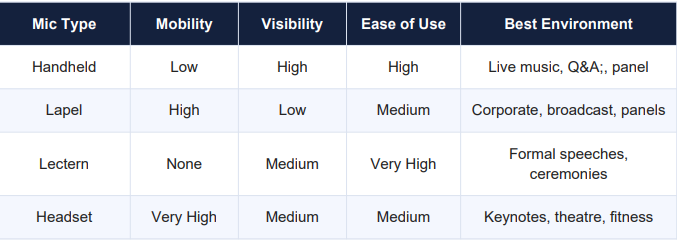
A Quick Comparison at a Glance
One Final Thought: Always Have a Backup
No matter which microphone you choose, have a contingency. Wireless systems can experience
interference. Batteries die. Clips fail. In a professional AV setup, there should always be a second option
ready, whether that’s a spare handheld on the presenter table, a lectern mic as a fallback for a lapel user, or
a fully tested spare transmitter in the wings.
The best microphone for your event is the one that suits the speaker, serves the space, and you’ve actually
tested before the doors open.
Fklef Productions is a leading UK-based AV technical company, dedicated to delivering seamless, flawless
events. If you have questions about microphone selection for an upcoming event, or want to discuss your specific
requirements, feel free to get in touch. Getting this right from the start will always be easier than trying to fix it on
the day.
Save this for your next event
Share with someone planning an event