Choosing the Right Microphone for Your Event: A Complete Guide
By Oluwaferanmi Makinde | Audio-Visual Technician & Live Sound Engineer
There’s a moment at almost every event — a keynote speech, a wedding toast, a corporate panel, where something goes wrong with the audio. The speaker fumbles with a microphone that doesn’t suit the format. There’s feedback. The audience strains to hear. The moment is lost.
In over a decade of working live sound at venues like ExCeL London, The O2, Tottenham Hotspur Stadium, and the InterContinental, I’ve seen this happen more times than I can count. And in nearly every case, the root cause is the same: the wrong microphone was chosen for the job.
Microphone selection isn’t just a technical checkbox. It shapes how your speakers feel on stage, how your audience experiences the event, and ultimately, how professional your production looks and sounds. Get it right, and nobody notices — which is exactly the point. Get it wrong, and it becomes the thing everyone remembers.
This guide will walk you through everything you need to consider before you decide between a handheld, lapel (lavalier), lectern, or headset microphone for your next event.
Before You Choose a Microphone Type: The Questions You Must Ask
No single microphone type is universally “the best.” The right choice depends on a combination of factors specific to your event. Before committing to any option, work through these foundational questions.
- What Is the Nature of the Event?
The event format is your first filter.
A conference with back-to-back keynote speakers has very different audio demands from a music performance, a panel discussion, a awards ceremony, or a theatre production. Consider:
- Is this a formal or casual setting?
- Will there be one speaker or multiple?
- Is the speaker presenting from a fixed position or moving around?
- Will there be audience interaction — Q&As, crowd participation?
- Is this being recorded, livestreamed, or broadcast?
Each of these factors will immediately narrow your options. A speaker who paces the stage during a TED-style talk has entirely different needs from a newsreader behind a fixed desk.
- How Much Freedom Does the Speaker Need to Move?
This is perhaps the single most important question in microphone selection.
Movement and microphone type are directly linked. If your speaker needs to gesture broadly, walk to different parts of the stage, interact with props or screens, or move through the audience — you need a wireless, hands-free solution. If they’re rooted to one spot, a fixed or handheld option becomes viable.
Ask the speaker (or their team) directly: “How much will you move during your presentation?” You’d be surprised how often this simple question is never asked — until the speaker starts walking off-mic.
- What Is the Acoustic Environment?
The venue itself is a microphone’s biggest enemy or best friend.
- Large, reverberant spaces (conference halls, cathedrals, stadiums) require microphones with tighter polar patterns and strong off-axis rejection to avoid picking up reflections and room noise.
- Small, treated rooms are more forgiving and allow more flexibility.
- Outdoor events introduce wind noise, varying distances, and unpredictable ambient sound — which demands ruggedised, directional microphones and careful frequency planning.
- High-noise environments (conferences with concurrent sessions, event floors, festivals) demand microphones that can isolate the intended source efficiently.
Always walk the venue before making your final microphone decision if possible. What works in a dry studio won’t necessarily work in a marble-floored banquet hall.
- What Does the Speaker Look Like on Camera?
If your event involves video recording, livestreaming, or broadcast — even just for social media — the visual presence of the microphone matters enormously.
A chunky handheld microphone may be perfectly functional but can dominate the frame in a close-up shot. Conversely, a barely-visible lapel can give a polished, broadcast-quality aesthetic. This is why television presenters and corporate webinar hosts almost universally favour lapels and headsets — the microphone disappears from the visual story.
If your event is audio-only, this consideration drops significantly. But for any camera-facing scenario, factor in the visual.
5. What Are the Speaker’s Preferences and Comfort Level?
A microphone that a speaker is uncomfortable using will always underperform technically.
Some speakers are experienced with lapel microphones and can self-fit them confidently. Others find them fiddly, distracting, or intrusive — particularly if they need to be clipped near the neckline or require a transmitter pack worn on the body. Some speakers have strong preferences from past experience; these should be taken seriously, not dismissed.
Comfort translates directly to performance. When a speaker isn’t thinking about the microphone, they communicate better. That’s always the goal.
6. How Many Speakers Are Involved?
Single speaker? Multiple simultaneous panellists? A revolving roster of presenters across a full-day conference?
Each scenario changes not just which microphone you choose, but how many you need, how you manage frequencies, and how complex your wireless coordination becomes. Multiple wireless microphones operating simultaneously in the same RF environment require careful frequency scanning and management — something that directly affects your choice of microphone system, not just type.
At large events, I use tools like Shure Wireless Workbench and Sennheiser Wireless System Manager to coordinate frequencies and avoid interference. This becomes critical when you’re running eight or more wireless channels in a venue that may have other RF systems competing for spectrum.
7. What Is Your Budget?
Quality microphones, particularly wireless systems, span a significant price range. A professional-grade wireless lapel system from Sennheiser or Shure will perform far more reliably in a complex RF environment than a budget alternative — and in a live event setting, reliability isn’t optional.
Budget should be a real conversation, not an afterthought. Investing in the right microphone for the format can save far more in avoided problems than cutting corners.
The Four Main Event Microphone Types: A Deep Dive
Now that you’ve mapped out your event’s needs, let’s examine each microphone type honestly — strengths, weaknesses, and the scenarios where each truly shines.
🎤 The Handheld Microphone
What It Is
The handheld is the most recognisable microphone in the world — a cylindrical body gripped by the user, either wired or wireless. From concert stages to awards ceremonies to press conferences, it’s the icon of public address audio.
When It Works Best
- Live music performances — vocalists, hosts, MCs, and performers who are comfortable holding a microphone
- Awards ceremonies where acceptance speeches happen at a podium or on stage with a roving host
- Town halls and Q&A sessions where a microphone is passed among audience members
- Panel discussions with a moderator moving between speakers
- Events with confident, experienced speakers who are used to holding a mic
Strengths
Control and directionality. The speaker controls the microphone’s position relative to their mouth, which means a skilled user can adjust the distance to manage their own volume — pulling back for a loud moment, moving closer for intimacy. For experienced speakers, this level of control is genuinely useful.
Simplicity. There’s no fitting, no transmitter pack to hide, no clip placement to worry about. Pick it up and speak.
Visual impact. In the right context — a concert, a talk show format, an open-mic event — a handheld microphone is a prop as much as a tool. It signals that something live and authentic is happening.
Robustness. Handheld capsules are typically less exposed to the wear and environmental factors that affect lapels and headsets.
Weaknesses
Hands are occupied. Any speaker who needs to gesture, point to slides, hold notes, or use a clicker loses a hand to the microphone. This is a significant constraint for many presenters.
Inconsistent technique. Untrained speakers frequently move the microphone away from their mouth, drop it to their side while speaking, or hold it at the wrong distance — causing wild level variations that make the sound engineer’s job significantly harder and the audience’s experience inconsistent.
Not hands-free. It simply cannot be used in situations that require both hands — demonstrations, performances on instruments, physical interaction with materials.
Cable management (wired versions). A wired handheld introduces a cable on stage, which creates trip hazards and limits movement.
Key Considerations Before Choosing a Handheld
- Is the speaker comfortable holding a microphone throughout their entire presentation?
- Does the format allow one hand to be occupied?
- Is the speaker trained in handheld microphone technique?
- Will the microphone be passed between people — and is there a plan for hygiene (mic covers/windscreens)?
📎 The Lapel (Lavalier) Microphone
What It Is
The lapel microphone — also called a lavalier or “lav” — is a small, discreet microphone clipped to clothing, typically near the collar, lapel, or tie. It connects via a thin cable to a wireless transmitter pack worn on the body (usually clipped to a belt or waistband, or slipped into a pocket).
When It Works Best
- Corporate conferences and keynotes where speakers present alongside slides and need both hands free
- Television broadcasts, webinars, and livestreams where a visible microphone would distract from the on-camera image
- Theatre and drama productions where performers need complete freedom of movement
- Panel discussions where each panellist has their own dedicated microphone
- Trainers and presenters who walk the room, use props, or work with flip charts and whiteboards
Strengths
Hands-free. This is the lapel’s defining advantage. The speaker is completely unencumbered — both hands free, no prop to manage, no technique to maintain.
Consistent pick-up distance. Because the microphone is clipped to the body, the distance between the capsule and the speaker’s mouth remains roughly constant regardless of head movement. This produces a more consistent audio level than a handheld in untrained hands.
Invisible on camera. A well-placed lapel, concealed under clothing or positioned discreetly at the collar, effectively disappears on camera — essential for broadcast and streaming contexts.
Natural movement. Speakers behave more naturally when they’re not holding a microphone. This consistently produces better presentations.
Weaknesses
Clothing noise. This is the lapel’s biggest technical challenge. Friction between the microphone capsule and fabric — from movement, breathing, or even jewellery — creates handling noise that can be distracting or even unusable. Careful placement and securing technique mitigates this, but it requires experience.
Placement sensitivity. The lapel must be positioned in the right location for optimal sound quality. Too low and it picks up more chest resonance and less direct sound. Too close to the chin and it can pick up breathing. Placement is a skill that takes practice.
The transmitter pack. The wireless transmitter must be worn on the body — which requires clothing with a suitable place to clip or conceal it. Speakers in some outfits (dresses without belts, certain uniforms) may struggle. This should always be discussed in advance of the event.
Environmental sensitivity. Because it’s positioned close to the body rather than mouth, a lapel is more susceptible to being covered by hands, lapels, or necklaces — all of which instantly muffle the sound.
Key Considerations Before Choosing a Lapel
- Does the speaker’s outfit have a suitable location for both the microphone clip and the transmitter pack?
- Is the event being filmed or livestreamed (in which case, a lapel is strongly preferred)?
- Is the speaker physically active — walking, demonstrating, working with materials?
- Is there a briefing process to show the speaker how to fit and manage the system?
🎙️ The Lectern (Podium) Microphone
What It Is
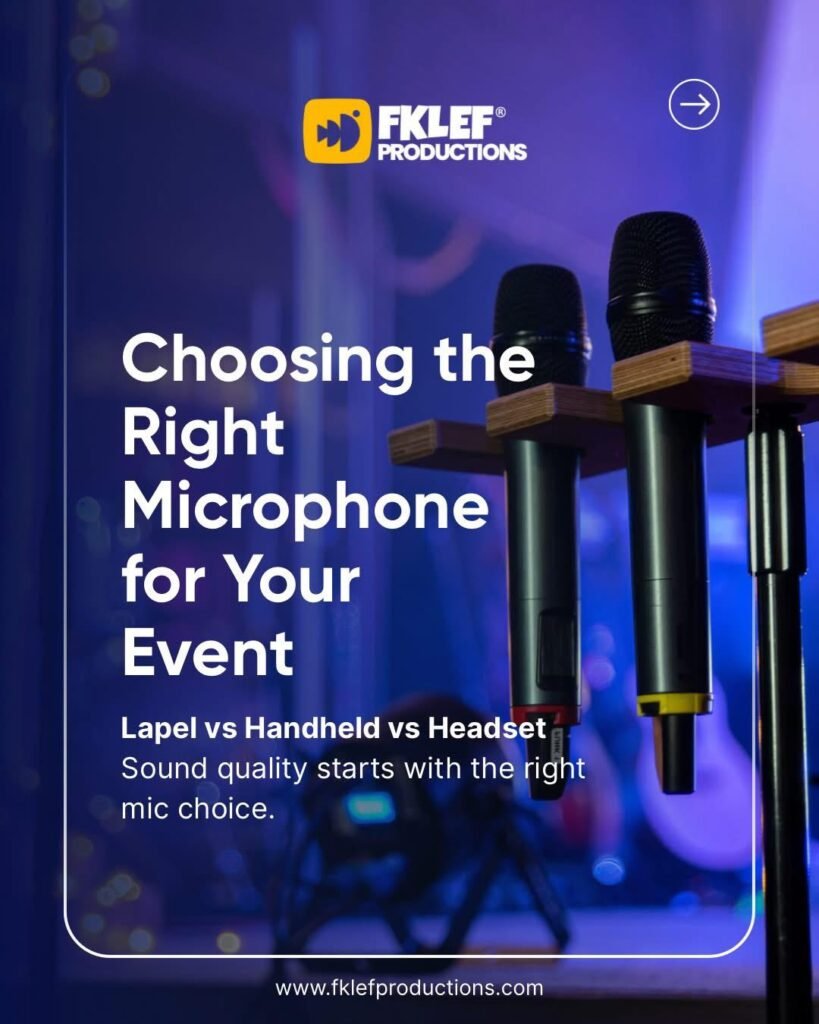
The lectern microphone is a fixed microphone mounted on a stand or directly integrated into a podium or speaking desk. It may be a single microphone or a crossed pair (two microphones positioned in an X-pattern to provide wider coverage). It can be wired directly to the PA system or feed into a snake/patch bay.
When It Works Best
- Formal speeches at galas, award dinners, graduation ceremonies, or religious services
- Government, legal, or official settings where a fixed, authoritative format is appropriate
- Conference speeches where the speaker will remain at the podium for the duration
- Situations where wireless microphones are impractical (very high RF congestion, low-tech environments, or extremely short-notice setups)
- Backup microphone for high-stakes speeches where redundancy is critical
Strengths
Simplicity and reliability. A wired lectern microphone has no batteries to die, no transmitter to fail, no RF interference to manage. It is the most technically reliable microphone option available, which is why it remains the default for high-stakes official environments.
No speaker management required. Nothing needs to be fitted, worn, or held. The speaker steps to the podium and speaks. There is zero friction for the speaker.
Established visual language. In formal contexts — a state address, a graduation, a formal dinner speech — the podium microphone is the expected and appropriate visual format. It reinforces the gravity of the occasion.
Easy to deploy. Setup is fast and requires no coordination with the speaker regarding fitting or preferences.
Weaknesses
Zero movement. This is the lectern microphone’s fundamental constraint. The speaker is anchored to the podium. Any movement away from the microphone causes an immediate and often dramatic drop in level. For dynamic, mobile speakers, this is simply not viable.
Head-turn sensitivity. Even at the lectern, speakers who turn their heads to address different parts of the audience can drop off-axis from the capsule — causing the familiar “fading in and out” effect that lectern microphones are known for.
Distance sensitivity. Lectern microphones are typically positioned to pick up a speaker at a defined distance. Short speakers, tall speakers, and those who lean in or back all present challenges that require either microphone adjustment or gain compensation.
Not hands-free in a useful way. While both hands are technically free, the speaker is still spatially constrained to the podium — which defeats much of the hands-free benefit for a presenter who wants to move.
Key Considerations Before Choosing a Lectern Microphone
- Will the speaker remain at the podium for their entire address?
- Is the event format appropriately formal for a fixed podium setup?
- Has the microphone height and angle been checked for the specific speaker?
- Is there a backup plan if the speaker unexpectedly steps away from the podium?
🎧 The Headset Microphone
What It Is
The headset microphone — sometimes called a “Madonna mic” after its popularisation by performers — positions the microphone capsule on a boom arm that wraps around the ear and positions the element directly beside or in front of the mouth. Like the lapel, it connects to a wireless belt-pack transmitter.
When It Works Best
- Performers and entertainers who sing and speak simultaneously
- Fitness instructors, trainers, and educators who are highly physically active
- Theatre and musical theatre performers who need hands-free audio with reliable positioning
- High-energy presenters who move significantly, gesture broadly, and need consistent audio regardless of head movement
- Environments with significant ambient noise where mouth-to-capsule proximity is critical for signal isolation
Strengths
Exceptional consistency. Because the boom arm maintains a fixed distance between the capsule and the mouth regardless of head movement, the headset delivers the most consistent pick-up of any wireless microphone type. The speaker can look left, right, up, down — the microphone follows them.
Superior gain before feedback. The proximity of the capsule to the mouth means the microphone can be run at lower gain while still capturing the speaker clearly — which dramatically reduces feedback risk in difficult acoustic environments.
Truly hands-free. Like the lapel, the headset leaves both hands completely free. Unlike the lapel, there is no clothing noise concern and no risk of the microphone being covered or displaced.
Ideal for physical performance. For aerobics instructors, performers, touring musicians, and high-energy presenters, the headset is often the only viable choice.
Weaknesses
Visual prominence. A headset microphone is highly visible — regardless of colour or design. In corporate settings, on camera, or in formal environments, this can feel incongruous or distracting. This is the primary reason headsets are less commonly used in straight conference or keynote settings.
Comfort and fit. Wearing a headset microphone for an extended period requires adjustment to find a comfortable fit, and some speakers find them uncomfortable, unfamiliar, or aesthetically undesirable. Speaker buy-in is essential.
Hair and make-up interaction. In settings where speakers have hair styled over their ears, or where make-up artists are involved, a headset can create complications that require advance planning.
Transmitter pack still required. Like the lapel, the headset requires a body-worn transmitter, introducing the same outfit-compatibility questions.
Key Considerations Before Choosing a Headset
- Is the speaker comfortable wearing a visible microphone on their head?
- Is the event context appropriate for a headset (performance, fitness, interactive presentation) rather than a formal corporate setting?
- Does the speaker’s role involve singing, physical activity, or extreme head movement that would cause other microphone types to struggle?
- Has the fit been tested and confirmed comfortable for the duration of the event? Putting It All Together: A Decision Framework
When I’m consulting on microphone selection for an event, I run through a simple decision tree:
Step 1 — Movement check:
Does the speaker need to move freely? If yes → eliminate the lectern. You’re down to handheld, lapel, or headset.
Step 2 — Hands check:
Do they need both hands free? If yes → eliminate the handheld. You’re down to lapel or headset.
Step 3 — Camera check:
Is this being filmed or broadcast? If yes → lean strongly towards lapel (invisible) unless the format is performance-based (in which case headset).
Step 4 — Activity level:
Is the speaker highly physically active, performing, or working in a high-noise environment where proximity to the mouth is critical? If yes → headset.
Step 5 — Formality check:
Is this a formal, fixed-position address (gala speech, official ceremony, podium presentation)? If yes → lectern is appropriate and reliable.
Step 6 — Speaker preference:
What does the speaker prefer? If they have a strong, informed preference, weight it seriously — comfort produces better performances.
A Final Word on Wireless Management
Choosing the right microphone type is only half the equation. In any event involving wireless microphones — which is the majority of professional events today — RF (radio frequency) management is equally critical.
Multiple wireless microphones operating simultaneously can cause interference, dropout, and intermodulation if frequencies are not properly coordinated. Always:
- Scan the RF environment before the event using tools like Shure Wireless Workbench or Sennheiser WSM
- Keep wireless transmitters away from Wi-Fi routers, DECT phones, and other RF-emitting devices
- Check battery levels before every session — not just at the start of the day
- Have a spare microphone and transmitter ready for every critical speaker
- Brief your speakers on how to handle, wear, and switch on/off their microphone
The best microphone in the world, poorly managed from an RF standpoint, will let you down at exactly the wrong moment.
Summary: Quick Reference Guide
| Microphone Type | Best For | Key Strength | Key Limitation |
|---|---|---|---|
| Handheld | Music, MC, Q&A, awards | Control, simplicity, visual impact | Occupies a hand, technique-dependent |
| Lapel | Corporate, broadcast, theatre | Hands-free, invisible on camera | Clothing noise, outfit-dependent |
| Lectern | Formal speeches, official settings | Reliability, zero speaker management | No movement, head-turn sensitivity |
| Headset | Performance, fitness, high-energy | Consistent proximity, best isolation | Visually prominent, comfort-dependent |
Choosing the right microphone is ultimately about serving the speaker and the audience — not about having the most technically impressive system. The best setup is the one nobody notices. When the audio disappears into the background and the message comes through clearly, you’ve made the right choice.
If you have questions about microphone selection for an upcoming event, or want to discuss your specific requirements, feel free to get in touch. Getting this right from the start will always be easier than trying to fix it on the day.
Oluwaferanmi Makinde is an Audio-Visual Technician and Live Sound Engineer based in London, with over a decade of experience across concerts, conferences, festivals, and corporate events at venues including ExCeL London, The O2, Pan Pacific London, and Tottenham Hotspur Stadium.